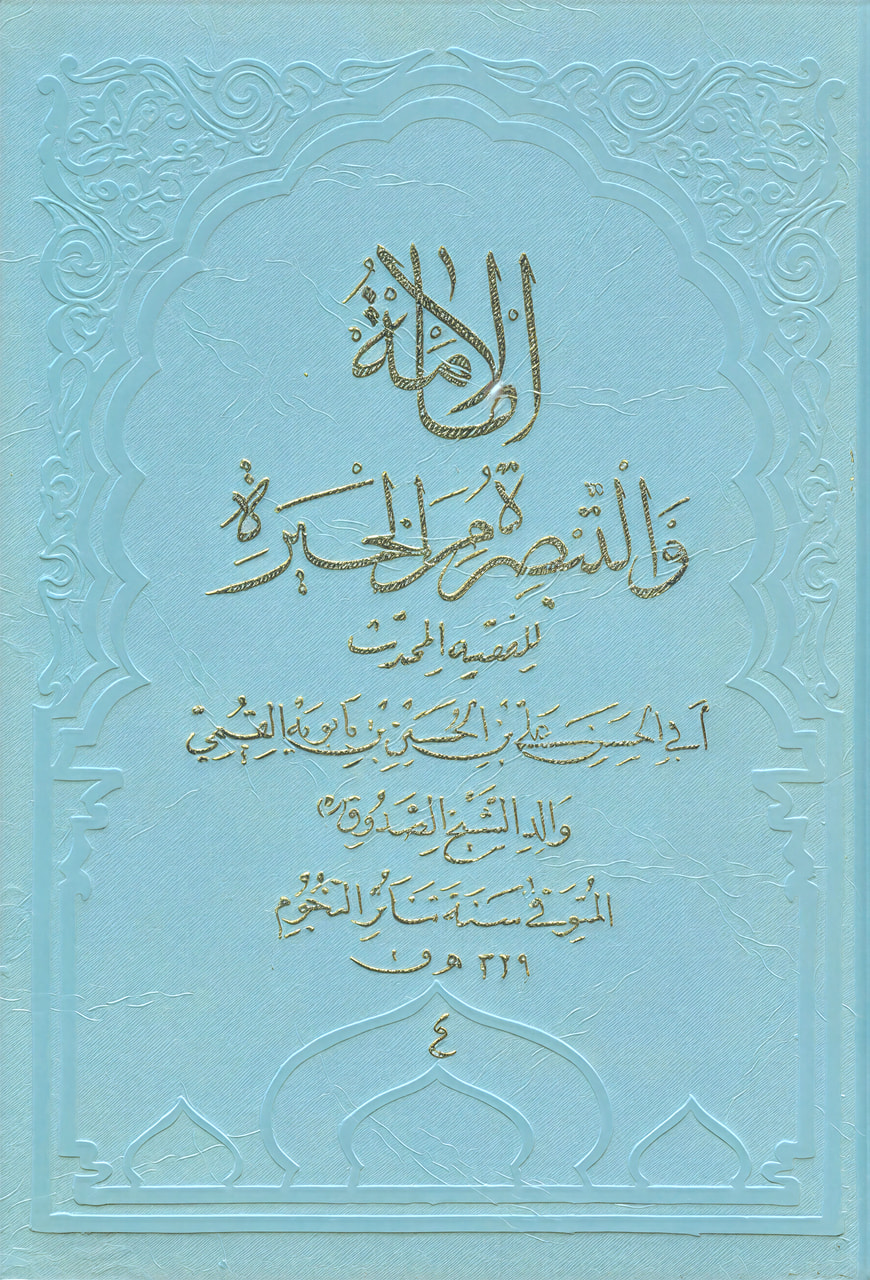
Al-Imāma wa’l-Tabṣira min al-Ḥayra (Divine Leadership & Insight amidst Confusion), compiled by ʿAlī ibn Bābawayh (d. 329 AH), the father of Shaykh al-Ṣadūq, is an early Imāmī Ḥadīth collection on Divine leadership and the continuity of the Imamate. Written during the Minor Occultation, it addresses the uncertainty experienced by believers in the absence of the Twelfth Imam. The author explains that he gathered these reports to dispel confusion, clarify the identity and number of the Imams, and strengthen believers through a prolonged period of waiting.
The introductory material presents traditions on the Imams alongside the author’s preface and a discussion of differences in transmitted reports. It connects recognition of the Imam with understanding and practising the religion, establishing the concerns that guide the work as a whole.
The main body moves from the continuity of Divine guidance and the principle that the earth is never without a Divine Authority to the appointment and succession of individual Imams. Its chapters examine the transmission of the Imamate within the Prophet’s family, address rival claims to leadership, and explain the responsibilities of believers when an Imam passes away.
This edition also includes an editorial addendum drawn from reports that Shaykh al-Ṣadūq transmitted from his father. It extends the discussion to the later Imams and the Mahdī, covering his birth, the signs by which he is recognised, his occultation and reappearance, and the duties of those awaiting him. Together, these materials present an early account of Imāmī belief and the questions of guidance, succession, and steadfastness that shaped the community during the occultation.
Al-Imāma wa’l-Tabṣira min al-Ḥayra (Divine Leadership & Insight amidst Confusion), compiled by ʿAlī ibn Bābawayh (d. 329 AH), the father of Shaykh al-Ṣadūq, is an early Imāmī Ḥadīth collection on Divine leadership and the continuity of the Imamate. Written during the Minor Occultation, it addresses the uncertainty experienced by believers in the absence of the Twelfth Imam. The author explains that he gathered these reports to dispel confusion, clarify the identity and number of the Imams, and strengthen believers through a prolonged period of waiting.
The introductory material presents traditions on the Imams alongside the author’s preface and a discussion of differences in transmitted reports. It connects recognition of the Imam with understanding and practising the religion, establishing the concerns that guide the work as a whole.
The main body moves from the continuity of Divine guidance and the principle that the earth is never without a Divine Authority to the appointment and succession of individual Imams. Its chapters examine the transmission of the Imamate within the Prophet’s family, address rival claims to leadership, and explain the responsibilities of believers when an Imam passes away.
This edition also includes an editorial addendum drawn from reports that Shaykh al-Ṣadūq transmitted from his father. It extends the discussion to the later Imams and the Mahdī, covering his birth, the signs by which he is recognised, his occultation and reappearance, and the duties of those awaiting him. Together, these materials present an early account of Imāmī belief and the questions of guidance, succession, and steadfastness that shaped the community during the occultation.